The Forger Who Wanted Them to Know He Was Good
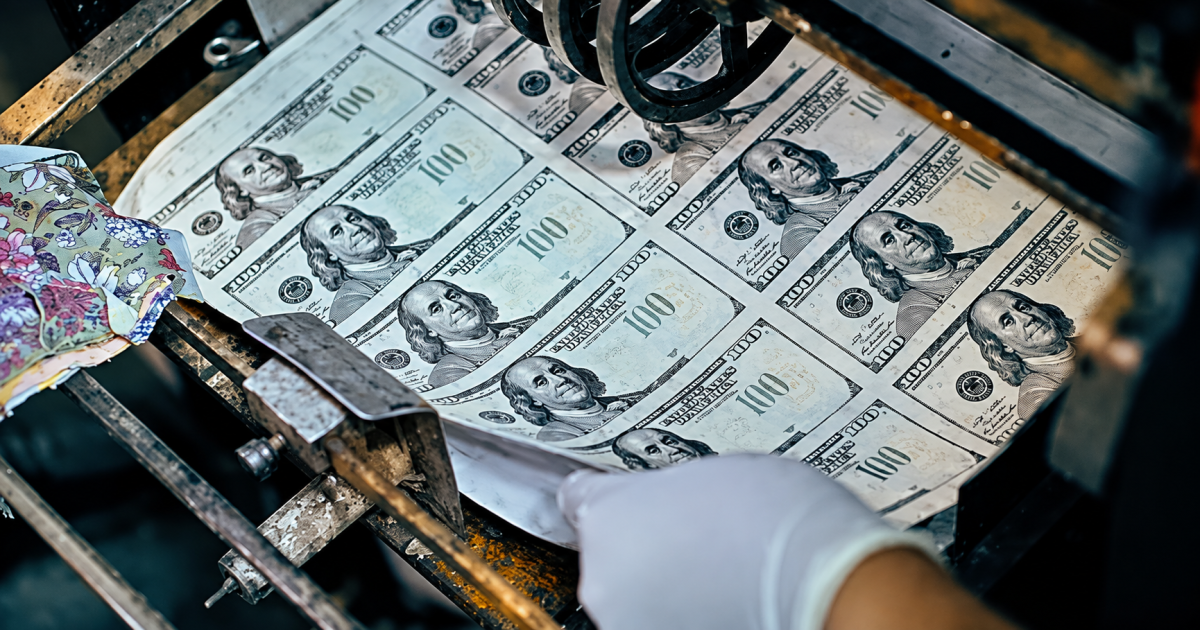
From the colonial Mint to the print shops of Azángaro: a story about Lima, its old graphic trades, and the strange problem of being very good at something you will never be able to sign.
A few days ago I stumbled, almost by accident, upon an episode of Trafficked, the National Geographic series in which Mariana van Zeller ventures into some of the illegal economies that are hardest to look at up close. This one was called Counterfeiting, and it took place in Peru.
The premise carried something between embarrassment and fascination: Van Zeller had come to Lima following the trail of Peruvian dollar counterfeiters. The program uses a rather revealing expression to describe them: gangster craftsmen.
Curiously, it was not the banknotes that stayed with me, but one of the interviewees. He is imprisoned in Lurigancho and speaks with his face covered. He has good reasons to preserve his anonymity — and yet he agreed to receive a National Geographic journalist and speak before a camera whose footage would end up being watched across half the world. There is something unsettling in that decision. The man had devoted himself to an activity in which being recognized amounts, almost by definition, to professional failure. He could not show his face, but he was willing to let us see what he knew how to do.
VIDEO: Counterfeiting (Full Episode) | Trafficked with Mariana van Zeller
While watching it, I remembered a story a professor told me many years ago about Jirón Azángaro, a street in the old center of Lima. According to him, the fame of downtown Lima's forgers had not appeared out of nowhere. It came from much earlier — from a tradition of coiners, engravers and printers reaching back to colonial times. At some point — this is how I remember the story — the minting of coins had been moved to other parts of the Viceroyalty, and some of those who knew its secrets found less official uses for what they knew.
It is one of those stories you hear in Lima and want to be true. So, years later, I went looking for it.
The first surprise is that a considerable part of the story exists. The second is that the most attractive part is precisely the one I have not been able to prove.
Lima Learns to Make Money
The Lima Mint — the Casa de Moneda — is almost as old as the Spanish city itself. Philip II ordered its creation by royal decree on August 21, 1565, and the first coins were struck in 1568. It initially operated next to the Viceroys' Palace, in the area of what is today the Government Palace. Lima was then barely thirty years past its Spanish founding, and there already existed here a group of people whose job consisted, quite literally, of manufacturing the thing everyone else was supposed to recognize as money.
There was, however, a rather practical inconvenience. The Viceroyalty's great source of silver lay far from Lima, in Potosí, and transporting the metal to the capital was expensive and inefficient. Viceroy Francisco de Toledo decided to bring coin production closer to the source of the metal, and in the 1570s Potosí began minting.
The history was considerably less orderly than a simple move from Lima to Potosí. For a period both mints operated simultaneously, and Lima's would later see closures and reopenings until its definitive reestablishment. But it is precisely in those movements that the story my professor told me becomes tempting. It is easy to imagine the changes leaving behind artisans who knew the working of metals, the dies, the matrices and the engravings — and some of them ending up using those skills outside the official circuit.
The problem is that I have found no evidence sufficient to claim it.
Nowhere — at least in the sources I have been able to review — does that unemployed coiner appear, the one who crosses the border between the official trade and forgery; nor any research that would let us follow a chain of masters and apprentices from the Mint to the Lima forgers of later centuries. Perhaps it exists, hidden in some archive. For now, turning that oral history into a fact would mean doing precisely what this article is about: producing a convincing copy and asking the reader to accept it as authentic.
The curious thing is that there is no need. The verifiable story turns out to be rather better.
Source: Central Reserve Bank of Peru — National Mint
Lima's Other Factory
While Lima was learning to make money, it was also learning another technology destined to change the city: the printing press. The Italian Antonio Ricardo arrived in Peru at the beginning of the 1580s, and in 1584 his workshop produced the Doctrina Christiana y Catecismo para Instrucción de los Indios, considered the first book printed in South America.
What matters for this story is not merely the arrival of a press. Around it there were types of different sizes, matrices for casting them, ornamental letters, utensils for preparing ink, paper, engravings, bookbinders and apprentices. A technology had brought with it a small human ecosystem.
And so, toward the end of the sixteenth century, two trades coexisted in Lima that we rarely think of together today: on one side, the men who struck the Viceroyalty's coin; on the other, printers, type founders and apprentices beginning to master the art of reproducing words and images. They would later be joined by the engravers, whose presence in the city would become especially important during the seventeenth and eighteenth centuries.
It may be a mistake to look for a colonial "School of Graphic Arts" with a building, teachers and students as we understand those words today. The teaching of those trades happened another way: in workshops, between masters and apprentices, around a press, a metal plate or a case of type.
By the mid-seventeenth century, copperplate engravings produced in Lima even began to be signed by their authors. The eighteenth century was an especially important period for that production. The National Library preserves the names of some of those masters. José Vázquez, for example, worked between 1759 and 1794; Marcelo Cabello carried the trade into the first years of the Republic. They made portraits of kings and authorities, religious prints, plans and maps.
What matters here is not so much what they depicted as the knowledge they had accumulated: they knew how to turn an image into a matrix, and a matrix into many reproductions. For generations, Lima had people capable of engraving, printing, drawing, casting type and reproducing with enormous precision.
Source: National Library of Peru — Printing in Peru
Much later would come the National School of Graphic Arts properly speaking. Around it, too, survive stories of former students of extraordinary skill who supposedly ended up on the wrong side of the trade. I have found no serious documentation that would justify describing that institution as a breeding ground for forgers, and doing so would be as unfair as it is historically irresponsible.
But the persistence of that legend says something interesting about Lima. When the city tried to explain to itself where the skill of some of its forgers came from, it looked for the answer among its own artisans.
The Fraud Was There Long Before Azángaro
There is another colonial episode that complicates the story further. Potosí — precisely the place to which much of the minting had moved — was the scene, in the seventeenth century, of one of the great monetary scandals of Spanish America.
Coins were required to contain a certain quantity and quality of metal. For years, however, adulterated Potosí pieces circulated. The fraud grew large enough to damage confidence in that coinage far beyond the Viceroyalty, and the investigations ended up implicating people linked to the mint itself. The Crown responded with trials and severe punishments.
The historical irony is hard to improve upon: the problem of falseness had managed to enter the very institution charged with guaranteeing what counted as true money.
We are not yet facing the modern counterfeiter clandestinely printing a banknote. The techniques, the crimes and the context were different. But a problem appears very early that would accompany money for centuries: its value depends not only on the object we hold in our hand, but on the confidence that the object is what it claims to be.
And there were still several centuries to go before the name of a Lima street would become a synonym for that suspicion.
From the Workshops of the Old City to Azángaro
It is impossible to prove that those old trades flowed into modern forgery — but there is also no need to travel five centuries to find the moment when Lima acquired a rather less prestigious reputation for its ability to reproduce documents. For that, it is enough to walk over to Jirón Azángaro.
Those of us who grew up hearing the name know that for a long time "Azángaro" stopped meaning merely a street. It became almost a category. One could say that a certain document "had come out of Azángaro" and everyone understood the insinuation.
This part is documented. The anthropologist Jaris Mujica studied the informal networks operating around the Palace of Justice and found, in the last blocks of the street, an ecosystem of fixers, print shops, intermediaries and forgers. There were people who recruited clients on the street and steered them toward whoever could fabricate the required document.
One of the best details of his research is linguistic. In that small world, nobody needed to shout that they forged documents. The word used was far more innocent: trámites — paperwork. On the streets near the Palace you could find people offering paperwork and documents.
I cannot think of anything more Lima than that.
Source: Jaris Mujica's research on the networks around the Palace of Justice
The most curious thing is that this market operated practically in the shadow of the Palace of Justice. The geographic coincidence is hard to beat: while inside the Palace the State decided which documents, signatures and acts carried legal value, a few blocks away there were people devoted to reproducing the material signs by which that authority was recognized.
The State issued a document, and someone studied how it was made. An authority stamped a seal, and someone learned what that seal looked like. A new format appeared and, sooner or later, someone figured out how to reproduce its appearance.
Perhaps that is a more interesting way to understand Azángaro. Not simply as a street of forgers, but as a place where two completely opposed activities ended up working around the same question: what does an object need in order for us to believe it is real?
And that question brings us back to the man in Lurigancho.
A Trade That Doesn't Let You Sign Your Work
There are professions in which recognition is a natural part of the job. The painter signs the canvas, the writer appears on the cover, and the architect can take his children to stand in front of a building and tell them he designed it.
The forger faces exactly the opposite problem. If he does his work perfectly, he disappears behind it. His best work is the one where nobody wonders who made it — because the moment someone recognizes the author's hand, the illusion begins to break.
That is where I understood what had really interested me about Mariana van Zeller's documentary. It was not the dollars, nor the technical skill required to imitate them. It was the strange relationship between a clandestine trade and recognition.
What does a person do with the pride of feeling exceptionally good at something they will never be able to sign?
That was when I thought of Walter White.
Walter White and the Problem of Recognition
The comparison with Breaking Bad may seem too easy, but it does not interest me for the obvious reasons. Walter White is a fictional character; Lima's forgers exist, and their crimes have real consequences. Nor is there any reason to confuse technical skill with moral merit.
The interesting parallel lies elsewhere.
For much of the series, Walter builds explanations for himself: the money, the illness, the need to secure his family's future. As the story advances, those explanations stop being enough, and an old wound related to recognition appears. Walter feels he has been more talented than his life ended up reflecting. Heisenberg offers him, among many other things, a world in which that talent finally produces reputation.
It is not merely about doing something exceptional. It matters that others know who did it.
The man interviewed by Van Zeller faces, at least from the outside, an inverse paradox. We do not know why he accepted that interview, and it would be absurd to invent a psychology for him. He may have done it for money, vanity, boredom, or for a reason the documentary does not even show. All we can observe is the scene: a man carefully covers his face while allowing an international camera to record what he knows how to do.
He needs us not to know who he is — but he has accepted that we know he exists.
The Story Lima Tells Itself
I still cannot prove the story my professor told me. I cannot draw a continuous line from a coiner in sixteenth-century Lima to an engraver of the eighteenth century, from there to the graphic schools of contemporary Peru, and finally to a clandestine print shop on Azángaro. That perfect line probably never existed. History rarely has the courtesy of being so tidy.
But once the legend is set aside, what remains are facts curiously close to one another. By 1568 Lima was already minting coins and, barely sixteen years later, printing books. Over the following centuries it produced generations of printers and engravers capable of ever more sophisticated work. Much later, a few blocks of downtown Lima gained notoriety for another kind of reproduction: documents manufactured to look like what they were not. And in the twenty-first century, a National Geographic journalist came to Peru following the trail of dollar counterfeiters and ended up describing that world with a word that seems to come from much further back: craftsmen.
None of this proves a criminal genealogy. To confuse historical coincidence with causality would be to ruin precisely the most interesting part of the story. What it does show is that Lima has spent almost five centuries gathering trades related, in completely different ways, to the manufacture of objects whose effectiveness depends on someone believing in them: a coin, a book, an engraving, a signature, a seal, a document. Sometimes the work consisted of producing the original; at other times, much later and at the margins of the law, of making sure nobody noticed they were looking at a copy.
It may be coincidence. To a large extent, it surely is.
But the next time I walk down Azángaro I will look at that street differently. Not because I believe a brotherhood of colonial engravers survives beneath its print shops. That belongs — until someone finds the document that proves it — to that magnificent collection of stories Lima has been telling itself for centuries.
I will remember, instead, the man from Lurigancho speaking behind a mask. Walter White ended up inventing Heisenberg because he needed his talent to have a name. The Peruvian forger could not allow himself anything of the sort: he needed to remain anonymous and, at the same time, he had accepted that an international camera would record what he knew how to do.
We do not know why he did it. But there is one possibility that is hard to dismiss and too human not to consider: perhaps he did not need us to know who he was. It was enough for him that we knew he was good.
Sources and Further Material
National Geographic — Counterfeiting | Trafficked with Mariana van Zeller
https://www.youtube.com/watch?v=XYzJBJi_5S0
Central Reserve Bank of Peru — National Mint (Casa Nacional de Moneda)
https://www.bcrp.gob.pe/billetes-y-monedas/casa-nacional-de-moneda.html
National Library of Peru — Printing in Peru (La imprenta en el Perú)
https://memoriaperu.bnp.gob.pe/micrositio/imprenta
Jaris Mujica — research on the informal networks and forgery around the Palace of Justice
https://www.scielo.org.mx/scielo.php?pid=S0185-39292011000200004&script=sci_arttext